Who Invented Binary Code? Leibniz and the Road to ASCII
Learn who invented binary code, what Leibniz contributed to binary arithmetic, and why ASCII text encoding has a separate history.
- Computing History
- ASCII
On this page
Who invented binary code? The modern binary arithmetic system is generally credited to Gottfried Wilhelm Leibniz, who lived from 1646 to 1716. He was not the first to work with numbers or calculation, but he was the one who invented a system for representing numbers in binary (base two) rather than decimal (base ten). Leibniz proposed using that system in a calculating machine, although the machine was never actually built.
Leibniz wrote about his ideas in a manuscript dated March 15, 1679, which discussed using binary arithmetic for computing. His account of binary arithmetic was included in the Académie des Sciences of Paris volume designated for 1703. It appeared in print in 1705.
Francis Bacon and Encoding Letters
A different way of thinking about encoding characters came from Francis Bacon, who described the printing press as one of the great inventions that changed the world. In The Advancement of Learning, published in 1605, Bacon discussed how to encode letters by arranging them in sequences of two alternatives. Although the text looked like ordinary text, some of the letters seemed to have slight variations in their fonts.
Historians are unsure if this account is accurate, but whether or not Bacon’s method ever worked, it shows an idea of encoding letters that was very different from arithmetic.
Binary Numbers and Character Codes
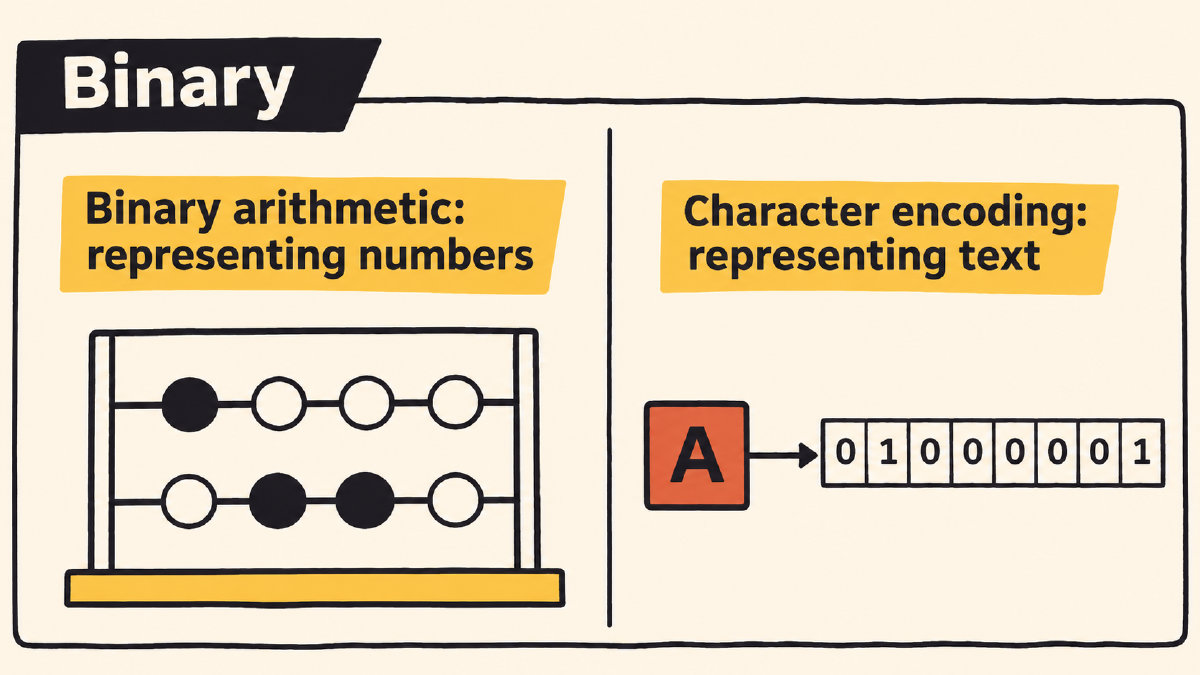
In fact, representing a number is different from assigning that number to a letter. In the case of numbers, we can use the value of the number to do calculations; in the case of letters, we need to know what each pattern represents.
For example, in ASCII, lowercase a has the decimal value 97, which is represented as seven bits: 1100001. But unless you know that a sequence of seven ones and zeros corresponds to a letter, you cannot tell what the code means. If you just see the seven bits, they are just a string of digits.
ASCII and Standardizing Character Codes
The process of standardizing character codes was separate from the invention of binary arithmetic. As computers became more common, people needed a way to represent letters, symbols, and controls electronically. In 1963, the American Standard Code for Information Interchange (ASCII) became the standard. It uses seven bits to represent 128 different code points, ranging from 0 to 127. This was a completely different project from Leibniz’s work.
So when a translator converts text to binary and back again, it is using a character encoding convention, which is separate from Leibniz’s work on binary arithmetic. The site translator I used to translate this paragraph into binary converted the text to binary and then back to text using the ASCII encoding convention, meaning that each character was translated into its corresponding bit pattern. Because the site is using UTF-8, which is backward compatible with ASCII, the data that went out was the same as the data that came in.
Sources
Try it yourself
Free, in your browser. Nothing you type is uploaded.
More in Binary Basics
- How to Find the LSB Bit in an ASCII ByteFind the LSB bit in an ASCII byte, see how changing it turns A into @, and distinguish bit significance from numbering and byte order.
- Bits and Bytes Explained Through ASCII and UTF-8 TextUnderstand bits and bytes with ASCII and UTF-8 examples: eight bits per byte, 256 patterns, and why letters and emoji use different byte counts.
- How BCD Code Stores Digits Differently from ASCII and BinaryLearn how BCD code stores each decimal digit, read four-bit groups, and distinguish packed and unpacked BCD from ASCII text and binary integers.