How to Find the LSB Bit in an ASCII Byte
Find the LSB bit in an ASCII byte, see how changing it turns A into @, and distinguish bit significance from numbering and byte order.
- Bit Significance
- ASCII
On this page
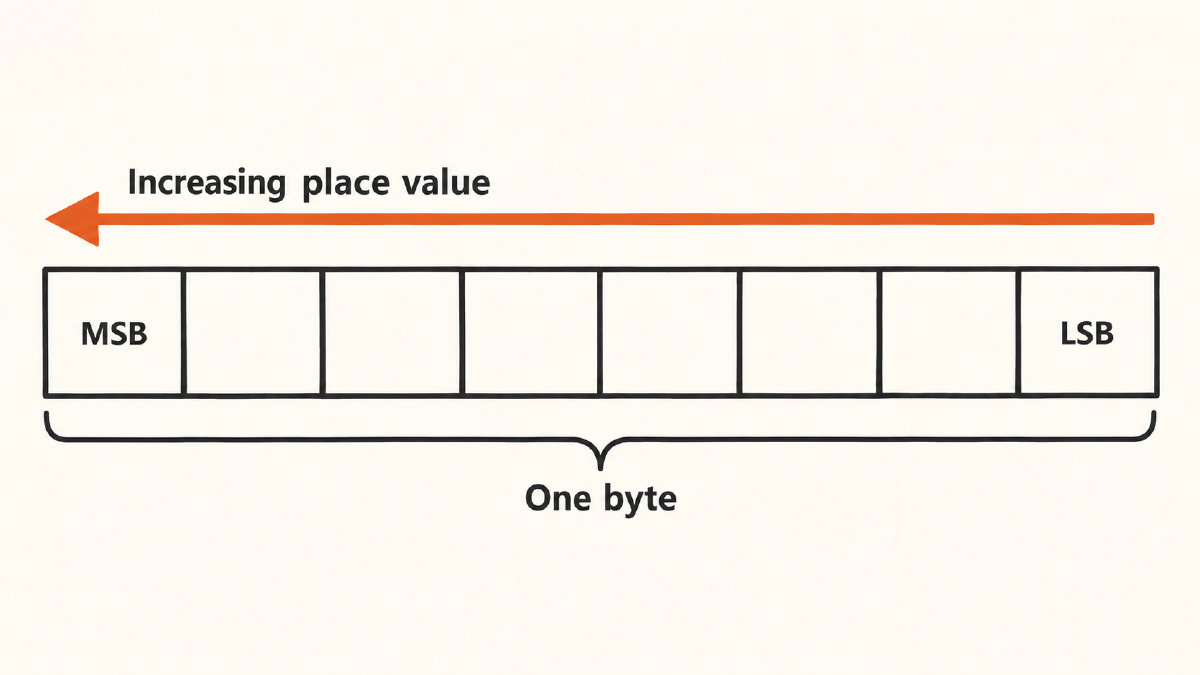
The lowest-order bit (also known as the least significant bit, or LSB) is the rightmost position of a conventionally displayed byte. The highest-order bit is the leftmost position. A bit’s significance is its place value, but that doesn’t mean that the bit contains either zero or one. (In fact, the term “LSB bit” is redundant: the “B” already stands for “bit.”) RFC 20 describes how seven-bit ASCII was embedded within an eight-bit byte, with the leading high-order 0 still regarded as the highest-order position.
Numbering Bits by Significance
Numbering bits from the least significant end, you can give a position the index 0 (the rightmost position) through 7 (the leftmost). You can also number from the most significant end, which would assign the same positions indices 7 through 0. But whether you choose numbering based on least-significance or most-significance doesn’t change the place value of the position itself. This matters when you’re encoding and decoding characters, as shown below.
RFC 20 says that b7 through b1 represent seven bits of ASCII data: b7 is the high-order bit and b1 is the low-order bit. So the rightmost bit is the lowest-order, or least-significant, bit. When you look at an ASCII character, say A, you can see that it’s made up of a sequence of bits. For example, A is represented by 65 decimal, which is 01000001 in binary. In this case, the ASCII code for A uses the column and row rules described in RFC 20: the first three bits determine the column, and the last four determine the row. Here, the column is determined by b7, b6, and b5 (from 100), so column 4; the row is determined by b4, b3, b2, and b1 (from 0001), so row 1. That gives us the ASCII pattern 1000001, where the leftmost bit is b7, followed by b6, then b5, down to b1.
The ASCII code for @ is 64, which is 01000000 in binary. Again, the leftmost bit of the eight-bit byte is the added high-order 0, followed by b7, b6, b5, down to b1. As before, the first three bits determine the column (from 100, which is again column 4); the last four bits determine the row (from 0000, which is row 0). That means that @ is encoded as 1000000, with the same left-to-right pattern as A.
If you now look at those two patterns and subtract them from each other, you’ll see only one bit has changed — the rightmost bit. And that makes sense: A and @ are only different in their rightmost bit. By changing that bit to 0 instead of 1, we’ve gone from A to @.
Significance Byte Order and Serial Order
Why do these terms matter? Because they describe what the bits represent and how they’re stored. Significance tells you the bit’s place value, regardless of whether it holds 0 or 1. Byte order determines how bytes are arranged in storage within a multibyte value, while serial order tells you which bit comes first within a sequence of bits. These concepts resolve any confusion about whether transmission order changes how a byte should be read on the page.
A positional bit’s significance describes its place value within a particular system. It is independent of the storage byte order and the value stored in that position. Positional indexing of bits is value-based, meaning that each bit can be assigned an index depending on its place value rather than the byte storage order.
Least Significant Bit First Transmission
The concept of least-significant-bit-first refers to the lowest-order bit being transmitted first. Most-significant-bit-first, in contrast, refers to the highest-order bit being transmitted first. When transmitting via serial transmission, or a stream of bits, the sequence of bits contained within bytes determines the serial order. Conventional written bytes, however, display the LSB on the far right, even if it’s actually transmitted first.
You don’t have to worry about the way the bits are transmitted unless you need to decode them yourself. The key takeaway is that the lowest-order bit (or least significant bit) is the rightmost bit, and that’s how you identify it in any given byte.
Sources
Try it yourself
Free, in your browser. Nothing you type is uploaded.
More in Binary Basics
- Bits and Bytes Explained Through ASCII and UTF-8 TextUnderstand bits and bytes with ASCII and UTF-8 examples: eight bits per byte, 256 patterns, and why letters and emoji use different byte counts.
- What Is a Binary File? How It Differs from a Text FileWhat is a binary file? Learn how it differs from a text file, compare actual bytes, and understand why translating them may not reveal readable text.
- What Is the Binary System? How 0s and 1s Store Text in a ComputerThe binary system is base-2, using only 0 and 1. See how bits, bytes and place values work and how computers store letters as binary with ASCII and UTF-8.