Special Characters Meaning Explained with Binary Examples
Understand special characters meaning through familiar punctuation and symbols, then see how ASCII and UTF-8 represent examples as binary bytes.
- Special Characters
- ASCII
- UTF-8
On this page
The everyday meaning of the word “special character” is a practical grouping of all punctuation and symbols. While we are familiar with the names (e.g., “exclamation point”), some names depend on context. ! is the exclamation point; @, the at sign; &, the ampersand; _, the underscore; ©, the copyright symbol. Depending on context, # is the number sign, hashtag, or pound key.
When we say that something is a special character, it usually means that the symbol falls outside of what we refer to as letters or digits. In ASCII, you have upper case and lower case letters (from 65 to 90, and from 97 to 122 respectively) plus digits (48 to 57), totaling 62 characters. The remaining printable characters, apart from the space, are commonly grouped as ASCII punctuation — and include the “special” symbols: !, @, #, $, %, &, etc.
ASCII doesn’t cover everything; however, many people think of special characters as those outside of the ASCII range. This isn’t accurate, though. Punctuation terminology has nothing to do with encoding ranges. For example, US-ASCII characters are encoded in UTF-8 as one byte, using the normal US-ASCII value.
The Period in Unicode and UTF-8
For the purposes of this article, let’s walk through a punctuation character. Take the period: “.”.
What does the period look like? It’s simply the visible character. Then there is the Unicode code point: U+002E, or hexadecimal 2E. Finally, the UTF-8 encoding will be its hexadecimal byte: 2E. So, converting each of these values into binary gives us:
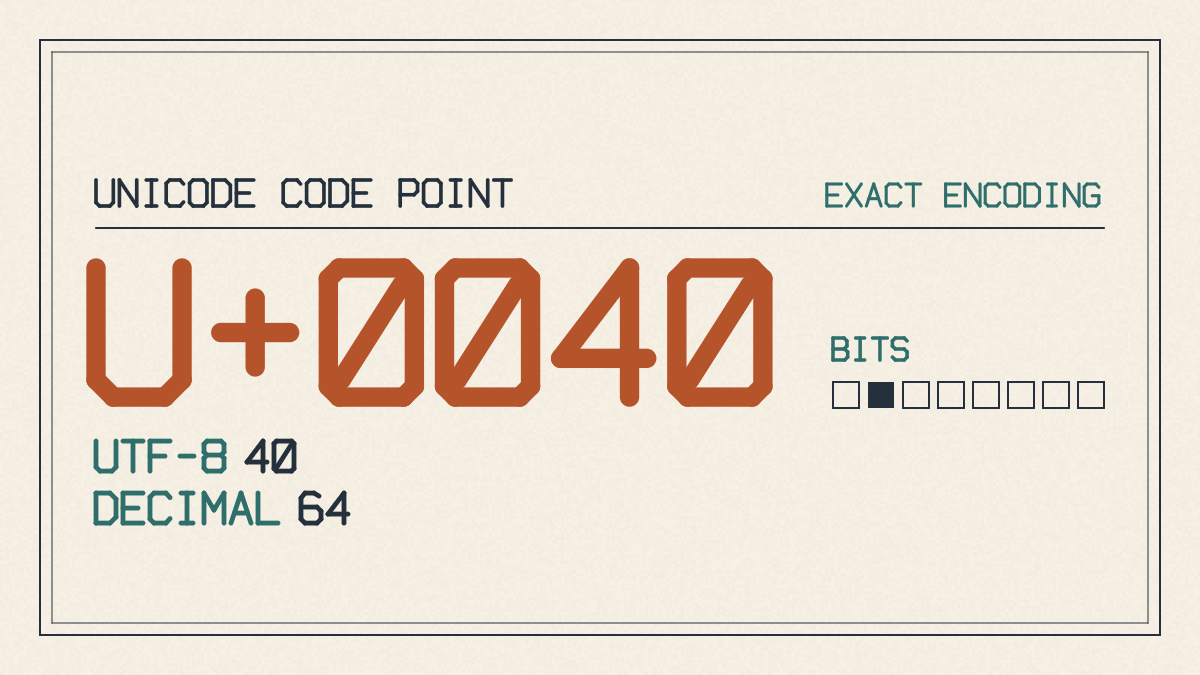
Unicode code point: U+002E → 00101110
UTF-8 encoding: 2E → 00101110
Thus, we end up with just one byte.
Symbols That Require More Than One Byte
In contrast, some symbols require more than one byte. Let’s take the symbol ≢, which means “NOT IDENTICAL TO.” The Unicode code point for this is U+2262, and UTF-8 encodes it as E2 89 A2. We can then break down each hexadecimal value to binary, producing three bytes. E2 → 11100010, 89 → 10001001, and A2 → 10100010: 11100010 10001001 10100010.
UTF-8 encodes different code points in either one, two, three, or four bytes. To determine how many bytes are used, it’s important to know what the code point represents. For the period, we only need one byte, but for ≢, three bytes are needed.
Sources
Try it yourself
Free, in your browser. Nothing you type is uploaded.
More in ASCII & Text Encoding
- How the Character Set Latin1 Extends ASCIIUnderstand the character set Latin1, its ASCII-compatible bytes, how é becomes 11101001, and why Windows-1252 differs.
- Free Printable ASCII Binary Code Worksheet with Answer KeyPrint a free ASCII binary code worksheet with a compact reference, encoding and decoding practice, and a separate answer key using eight-bit groups.
- How to Find the LSB Bit in an ASCII ByteFind the LSB bit in an ASCII byte, see how changing it turns A into @, and distinguish bit significance from numbering and byte order.